
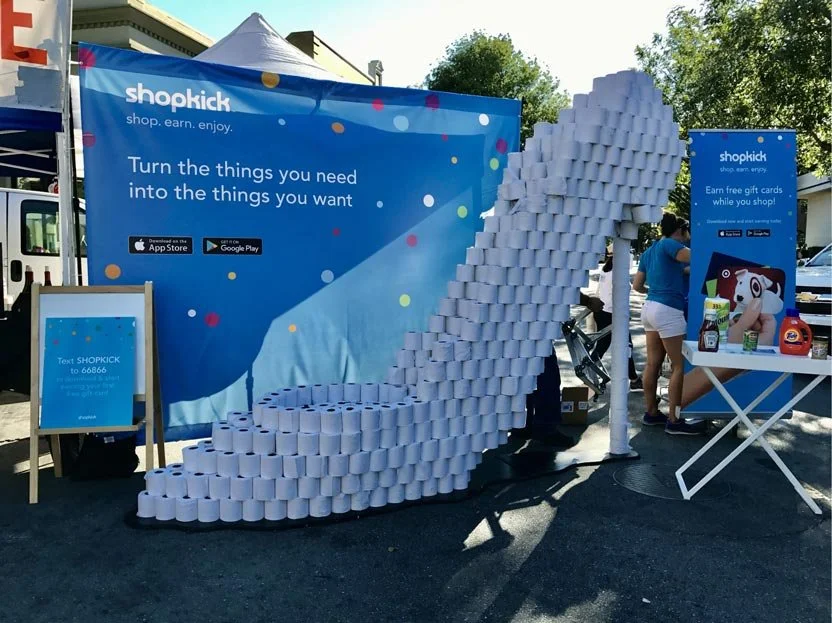
The Toilet Paper High Heel. Never available at Bergdorf.
Shopkick abruptly shut down last month, leaving a lot of people, well, a few people sad. (If a lot of people used it, it wouldn’t have shut down, right?)
But we have a special place in our hearts for Shopkick. Back when they came to us with their simple proposition, “people get points for the stuff they need to buy and earn gift cards for stuff they want to buy”, our brains immediately went somewhere incredibly mature:
“What if we built a gigantic high-heeled shoe out of toilet paper?”
Not metaphorically. Literally. A ten-foot-tall stiletto made from nearly 1,000 rolls of toilet paper. Because if buying toilet paper can eventually get you free shoes… then toilet paper is shoes. Obviously.
And Shopkick agreed with us. They loved the idea.
Turning rewards points into something people actually notice
Here’s the problem with most rewards platforms: everybody understands them intellectually, but nobody feels them emotionally.
“Earn points when you shop” is useful. It is not exactly the kind of sentence people text their friends. So instead of explaining the platform with diagrams and app screenshots, we decided to dramatize the exchange itself.
Toilet paper transforms into shoes. Boring household purchases become something aspirational. The entire value proposition becomes visible from 100 feet away.
Also: it’s hard to ignore a massive toilet paper stiletto sitting in the middle of a Taget parking lot. Which was sort of the point.
Retail media was getting crowded. So we got weird.
Shopkick’s platform worked through in-store beacons placed inside retailers like Target Corporation, Best Buy, Marshalls, CVS Health and hundreds of other stores.
The challenge wasn’t just awareness. We needed to get people to give a damn.
People are bombarded with messages about loyalty programs, cashback systems, memberships, browser extensions, rewards ecosystems, retail points, travel points, grocery points, and seventeen different apps all promising “exclusive savings.”
At some point, consumers stop hearing all of it. So instead of competing in the language of utility, we decided to compete in the language of spectacle.
The kind where somebody sees a giant shoe made of Charmin, and immediately pulls out their phone.
Yes, we really built three of them
One giant toilet paper shoe would have been irrational enough. Naturally, we built three.
Each sculpture anchored live sign-up events across the country, functioning somewhere between retail installation, publicity stunt, selfie magnet, and mild architectural concern.
The sculptures became conversation starters. People photographed them. Shared them.
Walked toward them. Asked questions. Which is usually a pretty good sign in advertising.
Especially in an era where most “experiential marketing” consists of forcing people to stand in front of a neon sign that says something like GOOD VIBES ONLY.
There’s something oddly satisfying about overcommitting to a dumb idea
Some of our favorite campaigns at Division of Labor start with an idea that sounds slightly too stupid to survive a meeting. That’s often a good sign.
Because memorable advertising rarely comes from moderation. It usually comes from someone pushing a thought one click further than everyone else was comfortable with.
“A shoe made of toilet paper” probably should have died in a conference room.
Instead, it became a ten-foot-tall physical object traveling around the country helping introduce people to a retail rewards platform. Advertising is strange. That’s why we like it.