

1950s Madison Ave. Men, cigarettes and martinis.
At some point after raising a Series A, most startups start thinking about advertising.
You've hired salespeople. You're spending more on marketing. You're showing up at conferences. Maybe you're considering video, out-of-home or a larger brand campaign.
So you start looking for an agency. Not so fast.
Don't Hire an Agency Too Early
Before you hire an advertising agency, make sure you're actually ready to advertise.
Most founders know what they're selling and who they're selling it to. But that's very different from knowing what you should say to those people.
Have you done any real consumer research?
Do you know why your customers buy the product?
Do you know whether that's the same reason your product team thinks they buy it? Note: It’s probably not.
Do you have a budget? Note again: $50,000 is not a budget. $300,000 starts to be a budget.
And do you have someone who can own the brand? Your marketing team may be great at product marketing, demand gen or growth. That doesn't mean anyone has ever run an advertising campaign.
You need someone inside the company who understands what you're hiring the agency to accomplish and has the authority to lead the relationship.
Of course, an agency can help you figure out some of those things. You don’t need to have all the answers. But a few of the answers would be good.
What Should You Keep In-House?
Before deciding what to give an agency, decide what you shouldn't.
Start with social media. Someone inside the company should post daily, know what's happening daily and be able to react to it without sending a brief to an agency.
Your lead design director should be internal too. Once you've established the brand, somebody needs to own it every day. Sales decks, product launches, conference materials, investor presentations none of it should require an agency every time someone needs a new asset.
Web development belongs inside, because your website changes constantly. Landing pages. Copy changes. SEO changes. You don't want to open an agency SOW every time the website needs an update.
Analytics and measurement should absolutely be internal. Your company should own the data, the dashboards and the definition of what success means. An agency can report on a campaign, but you own everything else.
The same goes for demand generation and marketing operations. Paid search, CRM, lead scoring, attribution, email nurture and the plumbing connecting marketing to sales are ongoing systems. They need people looking at them every day.
Product marketing should live inside because it sits between the product, sales and customer. As we covered in Product Marketing vs. Brand Marketing: Why Most Series A and B2B Startups Get It Wrong, features ship and sales hears new objections. Product marketing needs to be close enough to all of that to keep up.
The dividing line is pretty simple: if the job requires somebody to know what happened at your company this morning, you probably want that person working at your company.
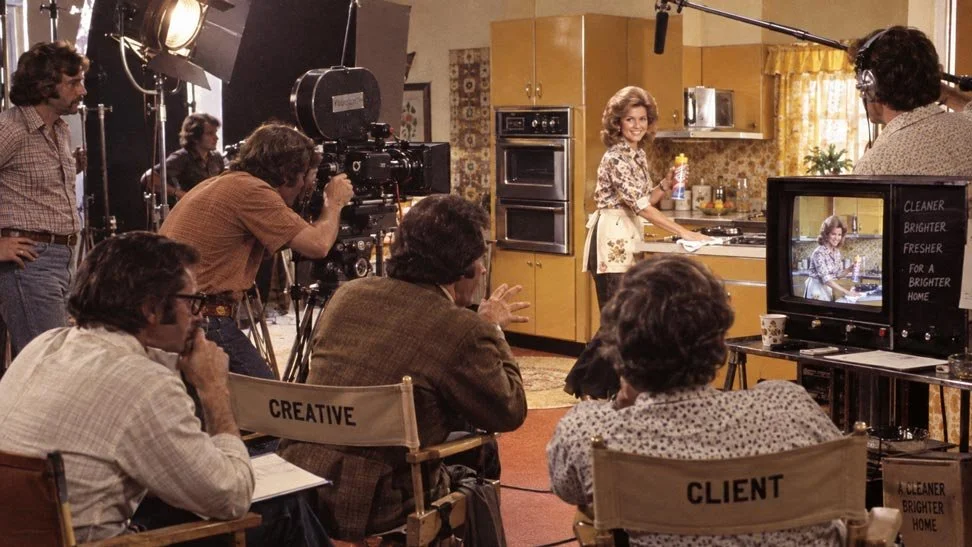
1970s. Longer hair, lots of jingles, plenty of mediocre ideas.
Hire Outside for Things You Don't Need Every Day
You probably don't need a creative director, art director, copywriter, broadcast producer and out-of-home media planner on staff every day. You probably don't need someone full time who knows whether that giant wall on Howard Street is actually worth what the media company wants to charge you.
But there are moments when you need all of them at once.
That's what an agency is for.
You're not hiring another pair of hands. You're temporarily adding capabilities your company doesn't need, or can't afford, to employ full time.
That's a very different calculation.
An Outside Perspective Matters A lot
There's another reason to bring in an agency that has nothing to do with headcount.
You work at your company all day, every day. You know every feature, acronym, competitor, objection from sales and sentence the lawyers won't let you say.
Eventually, it's difficult to see the company the way someone encountering it for the first time sees it.
That's where outside perspective has value.
A good agency should be asking questions your internal team may have stopped asking a year ago. Why should anyone care? Why is this different? Why would somebody remember it? Why does every company in this category use the same words? And what the hell does your in-house counsel know about advertising law?
Sometimes the most valuable thing an agency brings isn't another idea. It's distance.
Distance means being able to call B.S. on the things everyone inside the company has started taking as gospel. Maybe six months ago you decided the most important thing about the product was its AI architecture, so now every deck, homepage and sales presentation starts there. Meanwhile, customer research keeps telling you that people buy it because it saves them four hours a week.
An outside agency can ask why you stopped talking about the thing people actually care about.
That's harder to do from inside. A feature becomes important because the product team spent a year building it. A message survives because the founder likes it. A claim keeps showing up because it's been in the deck since Series A.
None of those are reasons for a customer to care.
An agency gets to look at your company from the perspective of people who do not care about your business.
Because that's the perspective that matters.
The consumer does not care about your business.
They don't care how hard the product was to build. They don't care about the feature your engineering team is most proud of. They don't care about your org chart, your internal terminology or the six things everyone at the company agrees are strategically important.
They care about themselves.
What does this do for me? Why should I pay attention? Why should I switch? Why should I remember you instead of the other five companies saying basically the same thing?
Someone needs to keep dragging the conversation back there.
That's one of the best reasons to hire an agency.

1990s. The rise of the creative boutique.
Five Signs You're Ready for an Agency
1. You Know What You're Selling
An agency can help sharpen positioning, but it shouldn't have to discover your business model for you. You should understand the customer, the problem you're solving and why people buy.
2. Your Sales Team Needs Air Cover
If your salespeople are walking into meetings where prospects haven't heard of you, they're spending the first ten minutes establishing credibility instead of selling. That's a brand problem.
And that's when you need an agency.
3. Your Category Is Starting to Look the Same
Go to the websites of your five biggest competitors. If everyone is using the same words, gradients, diagrams and claims, you have an opportunity.
You don't need more marketing. You need a point of view.
4. You're About to Spend Real Money on Media
This is a particularly bad time to save money on creative.
If you're about to spend $500,000 putting something in front of people, spending another $50,000 making sure it's worth putting in front of them is generally a better idea than putting mediocre work in front of twice as many people.
Media amplifies whatever you give it. Including boring.
5. Your Internal Team Is Already Busy
This one is less glamorous, but it's probably the most common. Your marketing team already has jobs: launching products, supporting sales, running demand gen, managing events, creating content and updating the website.
Now you're asking them to invent a brand campaign on Tuesday afternoon.
Something usually suffers.

When You Shouldn't Hire an Agency
Don't hire an agency because your board told you that you need "brand," because your competitor just launched a big campaign, or because you've raised money and feel like startups that raise money are supposed to advertise.
And don't hire one if nobody inside the company has the authority to make decisions.
That last one matters. Great work requires someone on the client side who can say yes.
If every headline needs approval from twelve people, three founders, legal, sales, product, HR and an investor who used to work at Google, the agency isn't going to solve your problem.
Agency vs. In-House vs. Freelancers
There's no universal answer.
Hire in-house when the capability is central to what you do every week. Hire freelancers when you know exactly what you need and mainly need someone to execute it. Hire an agency when the problem requires several specialized disciplines working together and you need an outside point of view.
If you already know the idea and need someone to animate it, hire an animator.
If you need to figure out what the idea should be, how it should look, where it should run, how it should be produced and how all of those pieces work together, you're probably describing an agency.
What Should an Agency Actually Do?
A good startup agency shouldn't become your marketing department. It should make your marketing department better.
Your internal team brings the product knowledge, customer knowledge, business strategy and institutional context. The agency brings perspective, strategy, creative expertise, production experience and specialized talent.
The best relationships aren't client/vendor relationships. They're small teams solving the same problem from different angles.
The Takeaway
You don't hire an agency because you've reached a particular headcount or funding round. You hire one when what you're trying to accomplish requires capabilities you don't have internally and don't need to build permanently.
Keep the knowledge and the day-to-day work close. Then bring in specialists when you need to do something bigger, different or better than you've done before.
That's usually the moment an agency earns its keep.
Previous in the series: Product Marketing vs. Brand Marketing: Why Most Series A and B2B Startups Get It Wrong
Next in the series: How Much Should a Series B Startup Spend on Brand Marketing?
#######
The Small Agency Blog is produced by Division of Labor; a top San Francisco ad agency and digital marketing firm. The award-winning creative shop specializes in startups that have obtained Series B funding or higher. They also offer freelance services. Click here for a free consultation.