
Ontra Campaign: Positioning AI Legal Tech for Private Equity
The Challenge
Ontra operates in one of the most complex categories in software: legal workflows for private equity. The product helps firms automate contracts, manage compliance, and streamline legal operations, but awareness inside the legal and private-markets ecosystem needed to grow.
The challenge:
How do we make AI legal tech legible to enterprise buyers? How do we reach private-equity decision makers, not just lawyers? How do we elevate Ontra from AI tool to category leader?

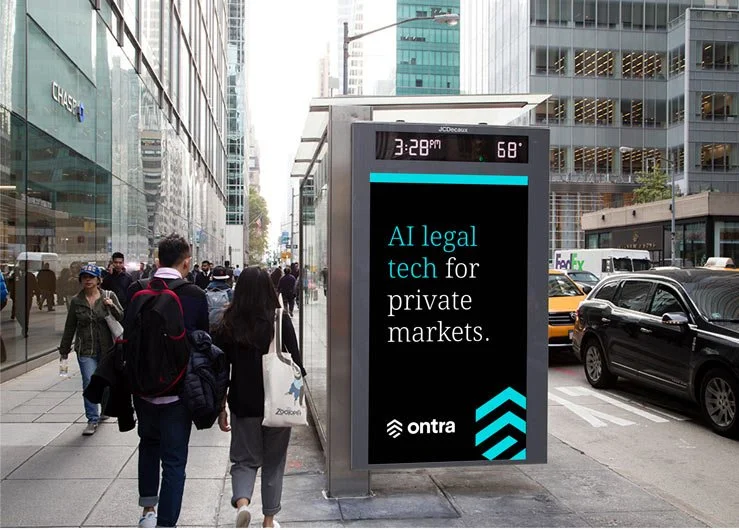
Billboards in NYC train stations in the city and suburban platforms on the Metro North line allowed multiple impressions with our target during each day of their commute.
The Strategy
We didn’t position Ontra as “another AI company.” We pushed up against the old way of doing things and positioned it as a whole new infrastructure for how private-equity firms operate. The Old Way vs New Way thinking allowed us to tap into the emotional frustration that people experience every day in this line of work.
This shifted the narrative from product features to lifestyle changer. AI becomes a workflow engine. Legal tech becomes a growth driver instead of a cost center.

General brand messages were mixed with specific problem/solution - old way/new way messages.
Creative Platform
Private equity runs on precision, compliance, and speed. The creative reframed legal operations from back-office burden to competitive advantage — anchored in Ontra’s role as a platform purpose-built for private markets.
The campaign spoke the language of general counsel, compliance leaders, and investment teams. And if you weren’t in the business, you didn’t understand anything other than this was a whole new way to do something.


Execution
Enterprise-Focused Messaging
The campaign translated AI automation into real business outcomes. Things like faster negotiations, clearer obligations and streamlined compliance. AI legal tech became tangible, not abstract.
Private-Markets Targeting
Messaging was built specifically for private-equity firms, fund operators, general counsel and compliance leaders. So the work met decision makers inside their category, not in generic AI conversations.

Ctrl-F is a big keyboard shortcut in private equity. It’s used to find specific terms in financial models, legal agreements and investor presentations. And compared to how Ontra works, Ctrl-F is a dinosaur.
Results
The campaign Division of Labor launched for Ontra generated a 56% increase in demo requests month-over-month. That’s an impressive statistic for a campaign introducing a very targeted AI technology to a niche market. Ontra tracked campaign mentions in Gong and uncovered many prospects who specifically cited seeing the Ontra ads as their reason for reaching out. Details HERE.
The campaign helped elevate Ontra from vendor to strategic platform in the private-equity ecosystem as it drove an increase in website traffic, brand awareness and branded searches.
Visibility and narrative alignment made sales conversations easier because buyers already understood the role Ontra plays.

Why It Worked
Private equity responds to operational advantage not the latest shiny object. This campaign didn’t sell AI. It sold precision, control and a new way of doing things that would deliver hours back into your day.
By speaking to how private-markets firms actually operate, the message felt native, not imposed.

About Division of Labor
Division of Labor is a San Francisco advertising agency specializing in brand and launch campaigns for Series A–C tech startups.
We help emerging companies:
Define categories
Reach technical and enterprise buyers
Translate complex products into market narratives
Companies like Ontra partner with us to move from product capability to industry positioning.
Campaign Overview
Ontra partnered with Division of Labor to position its AI-driven legal-tech platform for private-equity firms. The campaign reframed legal automation as operational infrastructure, building awareness and credibility among enterprise legal, compliance, and investment audiences.
-
To reach private equity lawyers and those creating funds within private equity firms, we focused our initial campaign effort on NYC. The majority of private equity firms are concentrated in central Manhattan with the majority of decision makers traveling to and from physical office spaces on a regular basis.
So we started by reaching people at the start of their commute points in upstate New York and Connecticut along the Metro North train line. For a brand with such a niche target, this outdoor was actually quite targeted and made the brand seem much bigger than it was.
Placements continued along the route inside Grand Central Station and then along multiple points on transit shelters and billboards within walking distance of the main private equity head quarters.
Follow-up media continued on LinkedIn where job titles and industry can easily be selected.
-
There’s a lot of money in private equity. And people in the space know what they’re doing. They have years of experience and everyone has their own, unique way of doing things. So they have to see a benefit that’s bigger and more tangible than just a general, “AI is more efficient” sort of message. They have to know that we understand the systems we’re asking them to change. They have to believe we get their business. They have to know we speak their language and get their pain. So we created a campaign with multiple executions focused on the exact types of tedious, minutia they deal with to build that trust.
-
There are too many brands and not enough colors. Very few sectors should rely on color ownership save for the car rental industry and maybe airlines. When you have a campaign with multiple executions, if each execution is the same color, it actually reduces the number of people who will read more than one or two. Why? They perceive that they’ve “seen that before” and gloss over. If you fill a subway station with messages of the same color, they become a single color of wall paper. If you break it up into multiple colors, like little M&M candies, people are more attracted and actually excited by the palette. Contrasting color palettes attract more attention than muted, similar shades. So if you want people to engage with your brand and read your messages, use more colors. If you just want to reinforce National Car Rental being the green company, then, ya, one color.